Vastu Shastra in Modern Interior Design: What Students Should Know
Vastu Shastra in Modern Interior Design: What Students Should Know
Walk into most Indian homes and you’ll notice something design textbooks don’t always cover: the kitchen is in the southeast, the main door faces a specific direction, and the pooja room sits in its own quiet corner. That’s Vastu Shastra at work — and whether you personally believe in it or not, understanding it is a practical skill for any interior designer working in India. Clients ask for it constantly, and knowing how to honor it without sacrificing good design is what separates a designer clients trust from one they don’t.
What Is Vastu Shastra, Briefly
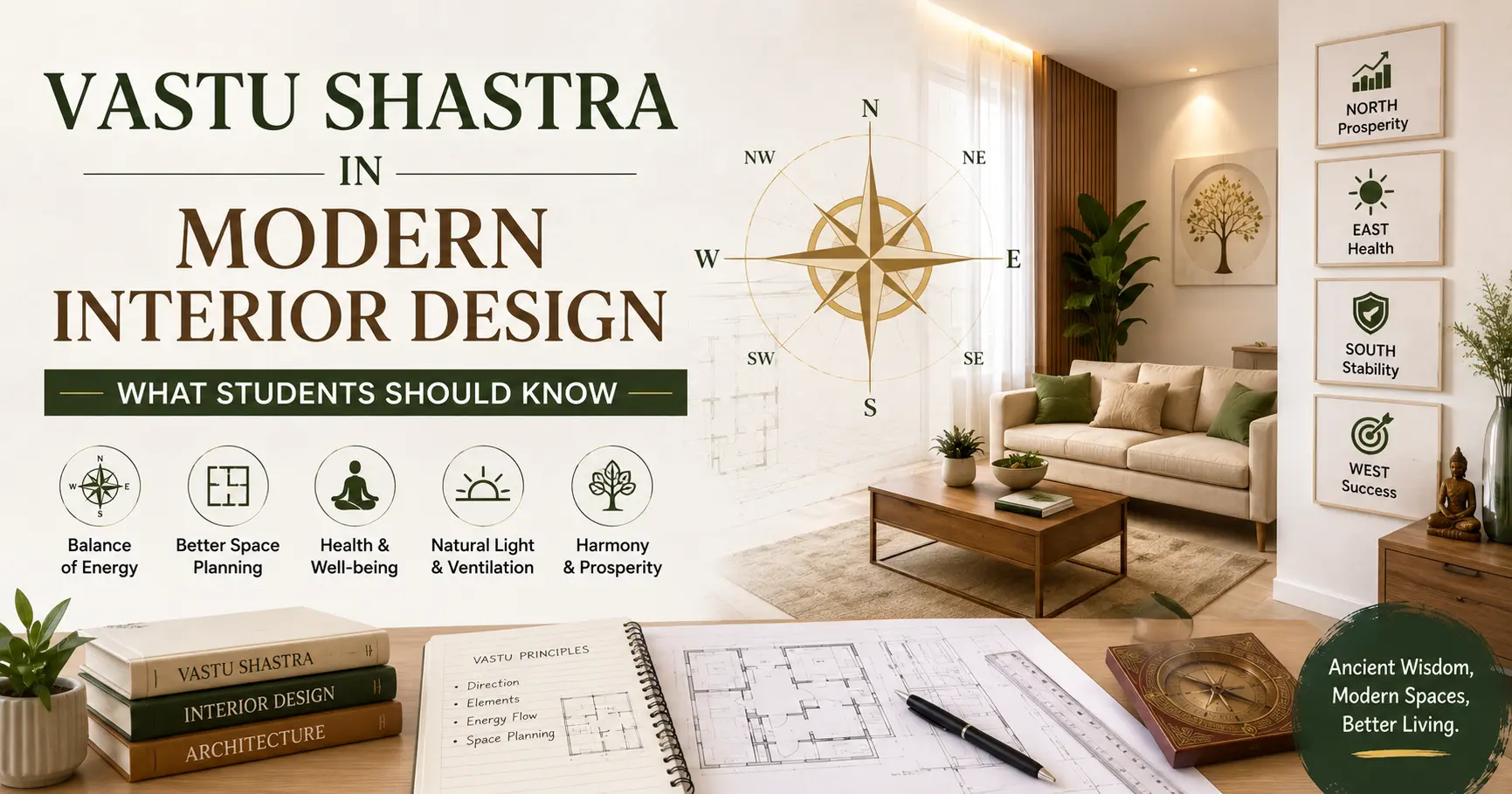
Vastu Shastra is a traditional Indian system of architecture that focuses on directional alignment, energy flow, and spatial harmony within a building. It draws on principles connecting the five natural elements — earth, water, fire, air, and space — to how a home is laid out. Many Indian clients, especially in Tier 1 and Tier 2 cities, still factor it into major design decisions.
Common Vastu Principles Designers Actually Encounter
- Main entrance: Often preferred facing north, east, or northeast for positive energy flow
- Kitchen placement: Traditionally recommended in the southeast corner, linked to the fire element
- Master bedroom: Usually placed in the southwest for stability and rest
- Pooja room: Northeast is considered the most auspicious placement
- Heavy furniture and storage: Positioned in the south or west to balance the home’s energy
Can Vastu and Modern Design Coexist?
Yes — and this is exactly the skill worth developing. Good designers don’t treat Vastu as a rulebook that overrides aesthetics; they treat it as one more constraint to design around, the same way they’d work with a tight floor plan or a client’s budget. A skilled interior designer can honor directional preferences while still delivering a layout that’s functional, spacious, and visually contemporary. It’s a negotiation, not a compromise.
How to Approach Vastu Requests as a Designer
- Ask early — find out if Vastu compliance matters to the client before finalizing a floor plan
- Prioritize the elements that matter most to them (often entrance direction and pooja room placement) rather than trying to satisfy every rule
- Use design elements like mirrors, lighting, and furniture arrangement to balance a room when strict directional placement isn’t possible
- Stay flexible — Vastu preferences vary by region, family tradition, and how strictly a client follows it
Why This Matters for Your Design Career
Residential design in India is one of the largest segments of interior design work, and a large share of homeowners factor Vastu into their decisions in some form. Designers who understand these principles — and can apply them thoughtfully rather than rigidly — are simply easier for Indian families to trust and work with. It’s a practical, real-world skill that complements your core design training.
Want to build strong residential design skills that go beyond the textbook? Explore FIDA’s Interior Design programs or get in touch to learn more about our curriculum.
FAQs
Do interior designers need to follow Vastu Shastra?
Not always — it depends on the client. Many Indian homeowners request it, so understanding the basics is a practical career skill.
Can a home be both Vastu-compliant and modern in style?
Yes, skilled designers balance directional principles with contemporary layouts and aesthetics.
What’s the most commonly requested Vastu element?
Main entrance direction and pooja room placement are typically the most important to clients.
Is Vastu Shastra taught in interior design courses?
It’s often introduced as part of residential design modules, alongside practical space-planning skills.
What if strict Vastu placement isn’t possible in a floor plan?
Designers use remedies like mirrors, lighting, and furniture arrangement to balance energy without altering the structure.